
Searching Dodge County Criminal Dockets
Felony cases in Dodge County belong to Superior Court. The Clerk of Superior Court is the main public records route for them. The clerk's calendar page posts criminal Status Hearings / Pleas plus a Plea Calendar as static PDFs. So the official calendar index is a practical first stop for a case with a recent setting. It is not a complete online register, though. The clerk's official Case Search link has been redirecting in a loop since August 20, 2026. That leaves the PDFs as the working option.
Read the event label and the case number together. A status hearing is a progress setting, not a ruling. A plea calendar centers on pleas and related criminal events. A Magistrate warrant, a municipal ticket, a Juvenile case, and a federal prosecution are not interchangeable with a Superior criminal docket. When the PDF falls short, call the criminal desk. Give the exact case number and ask whether you need the next setting, a disposition, a bond entry, or a filed document.
- Open the current Dodge Clerk criminal calendar and record the date, page, case number, and event label.
- Match the count or offense field and the representation block without copying private party details.
- Try the official case-search or Georgia E-Access route, noting the redirect or account limitation if it appears.
- Ask the clerk to verify the setting and identify the exact docket entry or document needed.
- Request a plain or certified copy only after the record type, date range, and delivery method are clear.
Reading the Dodge County Criminal Header
The official sample was generated August 28, 2026. It runs nine pages under the title Dodge County Plea Calendar. Its header reads CR SUPERIOR COURT CRIMINAL. That label identifies the event family and the court class, nothing more. The label does not mean every row is a final plea. It also does not replace the chronological criminal docket the clerk keeps.
Each page adds a generated date and time, a page count, a list number, the case number, and the filing date. It also lists time, count or offense, representation, a bond block, and a codefendant field. The alphabetical index up front is a finding aid. Treat it as a pointer, never as a stand-alone result. Do not copy its names into a public extract.
- Plea calendar
- A criminal setting list centered on pleas and related events.
- Status hearing
- A procedural setting used to report progress or choose the next step; it is not necessarily trial or disposition.
- Bond block
- Calendar fields for bond amount, date, or bondsman; presence is not a final case result.
- Disposition
- The recorded resolution or status of a case or count, using the court’s exact entry.
Inside a Dodge County Criminal Docket
Uniform Superior Court Rule 39 offers the best field map for a Dodge criminal docket. It lists the unique number, filing date, defendant and OBTS information, defense counsel, counts and offenses, and the accusation or indictment. Rule 39 also covers felony, misdemeanor, traffic and citation fields, pleas, jury status, disposition by count, and sentencing. Warrants, transcripts, appeals, remittitur, minutes, and a storage reference round out the list. A public PDF may show only a subset.
Know which layer you are asking for. The docket, the file, and the calendar are three different things. The docket is the indexed register. The file holds the indictment or accusation, motions, orders, the judgment, transcripts, and appeal papers. The calendar is just the event list. Request "the case" without naming the layer. You may get the wrong copy or an answer that only confirms a setting.
| Case number | Unique local identifier; the sample shows a YYR-number-judge-code pattern. |
|---|---|
| Count and offense | Separate charged offense and classification fields, where displayed. |
| Plea and jury status | Recorded responses and trial-status fields, not a prediction of outcome. |
| Representation | Attorney role such as Attorney for Defendant or PUBLIC DEFENDER. |
| Bond and warrant | Entries tied to the criminal case; confirm scope and current status with the clerk. |
| Disposition and sentence | Resolution and penalty fields, distinct from a calendar setting or hearing label. |
Dodge County Criminal Case Numbers
Criminal calendar examples show a visual form like 22R-2284-CMJ. The pattern runs YYR, then a number, then a judge code. That helps tell a criminal row apart from the civil calendar's YYV form. The letters and the final code have no published official key. Do not expand the code into a judge name, a charge level, a plea, or an outcome. The docket does not say.
Copy the entire case number, punctuation and suffix included, before asking for a record. When a search link fails or a calendar search returns nothing, check the court class and the date. Then call the clerk. A few things can mimic an empty result. An unindexed paper file can do it. So can a restricted case, a portal outage, or a number copied from a related case.
The local pattern is a matching aid, not a code book. The Clerk of Superior Court is the source for the meaning and current status of a criminal entry.
How a Criminal Case Moves
A criminal docket may show several stages, each with its own event and record layer. The path can be read as Filing › Arraignment › Pretrial › Plea or Trial › Disposition › Sentencing. Not every case displays every stage in the same order, and a calendar appearance does not prove that the stage ended that day.
After a disposition, the docket may pick up a sentence, a warrant, a transcript, a notice of appeal, a record transmission, or a remittitur. Report a dead-docket entry exactly as recorded. Do the same for a nolle prosequi, a dismissal, or any other disposition. Do not translate it into a broader claim. The clerk can also say whether the entry is public and whether you need a signed order or a certified judgment.
Dodge County Criminal Plea and Status
Two labels from the clerk give useful clues. "Plea Calendar" marks a list centered on pleas and related settings. "Status Hearings / Pleas" folds progress checks and pleas into one publication. Read the label with care, though. It does not show that a defendant entered a plea, that the case resolved, or that a later setting replaced the listed one.
| What appears | What it can tell you | What needs confirmation |
|---|---|---|
| Plea calendar | Case is placed on a criminal plea-related list | Whether a plea occurred and what disposition followed |
| Status hearing | Progress or next-step setting | Whether the case moved, reset, or remained pending |
| Bond block | Bond-related fields accompany a calendar row | Current bond status, release terms, or later order |
| Generated footer | Shows the PDF snapshot and page count | Whether a later PDF or clerk entry superseded it |
Courts That Hold Criminal Dockets
Superior Court is the central Dodge route for felony trials and related Superior criminal events. Magistrate Court handles warrants and preliminary matters. Municipal courts take city traffic, ordinance, warrant, and permitted local matters. Juvenile Court handles delinquency, dependency, CHINS, and juvenile traffic cases for children, with restricted access. Federal criminal cases belong to the Southern District of Georgia, Dublin Division. The Dodge Clerk does not hold them.
| Court class | Typical criminal record | Where to begin |
|---|---|---|
| Superior | Felony docket, accusation or indictment, pleas, sentence, appeals | Dodge Clerk criminal desk and calendar |
| Magistrate | Warrant, preliminary hearing, limited criminal matter | Magistrate Court, 478-374-7243 |
| Municipal | City traffic, ordinance, and local preliminary matters | Issuing city clerk or approved vendor |
| Juvenile | Delinquency and related juvenile proceedings | Oconee Juvenile route; restrictions apply |
| Federal | Federal criminal indictment and filings | Southern District PACER/CM-ECF, GASDC |
Dodge County Criminal Record Requests
Rule 39 breaks a criminal docket into parts, and that helps you ask for exactly what you need. The inventory covers the case number, filing date, counts, charging instrument, pleas, dispositions, sentence, warrants, transcripts, and appeal history. You do not have to request every field. Name the one you want, and the criminal desk can pull the right layer and quote a tighter copy fee.
The question shapes the request. Chasing an appeal? Ask whether the record shows a notice of appeal, transcript status, transmission, or remittitur. Chasing a sentence? Request the disposition or judgment, not just the calendar PDF. The statewide framework sits in the Uniform Superior Court Rules. The Dodge clerk answers local record and fee questions.
- State the court class and full case number.
- Name the event, document, or date range.
- Say plain copy, certified copy, inspection, or transcript.
- Ask whether access is limited by a seal, juvenile rule, or protected identifier.
Sealed Dockets and Public Access
Rule 21 treats court records as public first. Limits follow from law, procedure, or a judge's order. Juvenile records, adoption indexes, protected-identifier pages, and restricted files are not ordinary criminal search results. A redacted version can still confirm a proceeding exists while holding back the protected material.
Rule 21.6 requires the clerk to seal a separate page holding protected identifiers in protective-order filings. Rule 36.17 generally limits pleadings to the last four digits of Social Security, tax, or account numbers plus the year of birth. The filing party or counsel must do the redacting. An entry can vanish from a docket search. Ask the clerk whether it is sealed, restricted, not digitized, or held by another court.
Access boundary: the Eighth District pro se resources link to sealing and related forms, but current Dodge filing steps and any fee must come from the clerk.
Dodge County Criminal Drug Court
Dodge County Adult Felony Drug Court appears in an official Judicial Council funding document. Georgia's accountability-court materials cover the statewide network. The Dodge/Oconee area counts as part of it. So the program exists. That evidence does not give you a participant list. It also leaves out an intake calendar, treatment records, and any public case-level docket. Treat it as proof of the program and nothing more.
A participant's underlying Superior criminal case can still have public docket events. Search by the official Superior case number. Treatment reports, testing, clinical material, and team records stay restricted. Some are simply unavailable. Once you find a docket entry, ask the clerk whether a particular order is public before you rely on it.
One caution worth repeating: a drug-court appearance on the calendar proves nothing by itself. It does not show compliance, completion, or eligibility.
The Judicial Council source is a program and funding reference only. It cannot stand in for the Clerk of Superior Court's current criminal record.
The Oconee Judicial Circuit page lays out the regional court structure that handles Dodge's Superior criminal calendar. The local clerk still answers specific case-entry questions.
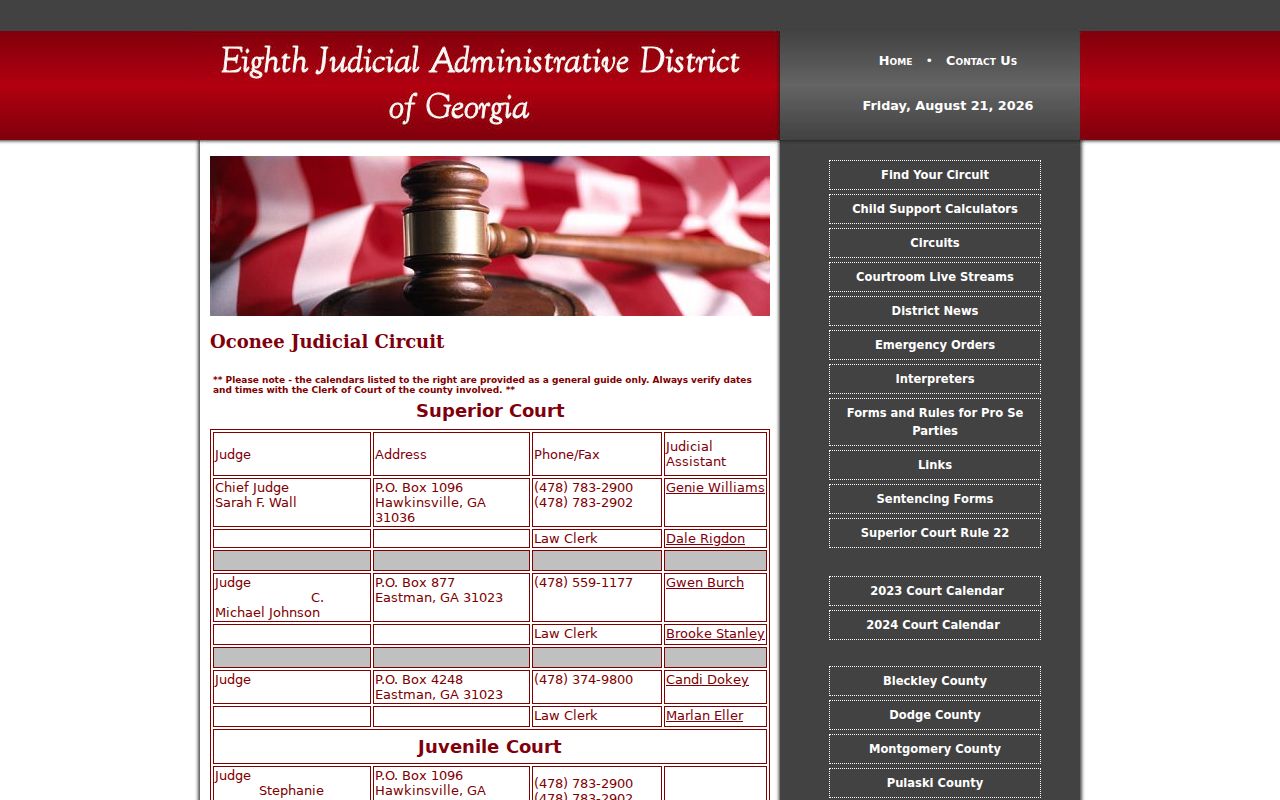
That circuit page gives you geography, not answers. For any specific Dodge County criminal case, the official calendar and the clerk’s office control.