
Getting Dodge County Court Records
Most Superior Court files, civil and criminal, run through the Clerk of Superior Court. That office posts calendars, forms, and a case-search link, and it answers the phone. You can also walk up to the counter, mail a written request to P.O. Drawer 4276, or call 478-374-2871. The county's general Open Records Policy works for administrative records. But send a court-file request straight to the court that holds the file.
Open the Dodge Clerk home page to check the current office path. Then ask for the exact item by name. Georgia Courts E-Access lists Dodge Superior through a provider and requires an account. Magistrate, Probate, Juvenile, municipal, and federal records each live with separate offices. So confirm the right desk before you request anything.
- Identify the court class and full case number, if known.
- Name the precise record, such as docket sheet, complaint, order, judgment, disposition, transcript, or calendar.
- Give a date range and state whether inspection, a plain copy, or a certified copy is needed.
- Choose counter, mail, phone, fax, electronic delivery, or another method the office confirms.
- Ask for search, copy, certification, postage, and transcript charges separately.
Dodge County Court Docket Metadata
A docket entry records the case number and the event. It also lists a filing or disposition date, the judge, the count or cause, and the status. A calendar snapshot lists settings for one date. Behind each index line sits a filed document. That document may be the complaint, indictment, motion, answer, order, judgment, transcript, return, or appeal paper. A certified copy is a clerk-attested reproduction made for official use. Each layer answers a different question about the case.
| Layer | What it tells you | Where to ask |
|---|---|---|
| Docket metadata | Case number, event, filing, disposition, judge, and status | Clerk or case-search route |
| Calendar snapshot | Cases and settings listed for a date | Clerk calendar PDF and verification call |
| Filed document | Complaint, motion, answer, order, judgment, transcript, or appeal paper | Actual court clerk |
| Certified copy | Copy with clerk certification and custody statement | Clerk, with current fee quote |
| Administrative record | County policy, meeting, facility, or budget record | County Open Records custodian |
A Dodge County case lookup can help you find the case number before you request documents. The search result alone is not a certified file, though, so plan on a separate copy request once you have the number.
Court Record Types
Superior civil and criminal files form the core of the county docket. Magistrate records hold warrants, preliminary matters, and limited civil claims. Probate covers wills, estates, guardianships, and licenses. Juvenile records carry special access limits. Municipal records handle city traffic and ordinance matters. Federal cases sit with the Southern District of Georgia or its bankruptcy court.
Land and UCC records are a different Superior Clerk family. Dodge links GSCCCA and COTT for deeds, liens, plats, UCC filings, and related documents. Those systems are not a criminal or civil case register. Ask the clerk which desk owns a record before choosing a portal.
Dodge County Court Clerk Forms
The official forms page lists Notary, Protective Order, and UCC categories. But the individual form fields do not always render. So confirm current filing requirements, fees, and delivery method with the clerk. The Eighth District pro se page also links Magistrate appeal, family-violence, child-support, expungement, first-offender sealing, pauper-affidavit, and interpreter resources. A form from another circuit may need local adaptation. A form link is a route to a filing, not proof that the related case record is public. For a record request, a short written note works best. Include the case number and date range rather than a demand for every paper.
Check the Dodge Clerk forms page and the Eighth District pro se page for current versions. Do that before you file anything.
Inside a Dodge County Court Record
Rule 39 sets out field-level inventories for Superior civil and criminal dockets. The document file behind those entries holds the supporting papers. On the civil side, that can mean the complaint, service, answer, motions, pleadings, orders, judgment, Fi.Fa., transcript, appeal, and remittitur. A criminal file may carry an accusation or indictment. It may also hold counts, pleas, sentence, warrants, motions, transcripts, and appeal papers. Not every item is digitized, and not every item is open.
| Identity | Case or action number, court class, filing date, caption, cause, or count. |
|---|---|
| Procedural papers | Complaint, accusation, indictment, answer, service return, motion, or pleading. |
| Court action | Order, judgment, disposition, sentence, calendar entry, or hearing result. |
| Review record | Notice of appeal, transcript, record transmission, or remittitur. |
| Custody reference | Storage or file reference held by the clerk; not a public search field in every portal. |
Dodge County Court Identifier Rules
Georgia Rule 21 starts from public court records. But it allows access limits set by law, procedure, or court order. Rule 21.6 governs protected identifiers in protective-order filings. The public or redacted version is filed first. The unredacted material plus a proposed order go to the court. Rule 36.17 generally limits pleadings to the last four digits of Social Security, tax, or account numbers and the year of birth.
The filing party or counsel handles redaction. The clerk does not run a full privacy review. A request for an unredacted or sealed record therefore needs a specific legal route. Juvenile, adoption, and other limited-access files may not appear in a public search even when a proceeding exists.
Public does not mean unrestricted: review the Uniform Superior Court Rules and ask the clerk which redacted, sealed, or certified version is available.
Fees and Certified Copies
Dodge's public sources post no fee table. There is no posted price for plain docket copies, certified copies, search time, transcripts, or delivery. Ask the clerk to quote each part separately. A certified copy changes what a document can do officially, but it is not a stronger search result, and it says nothing about the merits of a case. Check with the receiving agency about what it actually needs. That could be a certified judgment, a file-stamped order, a disposition, a transcript, or another document.
| Possible charge | Dodge research status |
|---|---|
| Plain court-record copy | Current local fee not located; ask the Clerk of Superior Court |
| Certified copy or certification surcharge | Current local fee not located; specify the document |
| Transcript | Current reporter or court fee not located |
| County administrative request | First 15 minutes of labor free under the 2026 policy; further labor and copy costs may apply |
| Federal PACER document | Separate federal pricing; current inspected rate is $0.10 per page with a $3 document cap |
Dodge County Court Request Channels
The Superior Clerk offers more than an online route. The public office sits at 643 Pearl Bates Avenue, Eastman, Georgia 31023. P.O. Drawer 4276 handles mail, and 478-374-2871 takes phone calls. A fax line, 478-374-3035, is also available. The GSCCCA directory lists weekday counter hours of 9:00 a.m. to 5:00 p.m. Call before you travel. Confirm hours and the availability of a public terminal or copy station.
Records request route
Clerk of Superior Court
643 Pearl Bates Avenue
Eastman, GA 31023
478-374-2871
Mail: P.O. Drawer 4276
Magistrate questions go to 5018 Courthouse Circle, Suite 202, or 478-374-7243. Probate works through P.O. Box 514 and 478-374-3775, while juvenile matters follow the Oconee circuit route at 478-783-2900. The record may not be Superior. Take it to the lower court or city office that actually holds it.
Sealed Records and Public Access
Dodge County courts can close a record, but only through set rules. Rule 21.1 lets a judge limit access. The required procedure must be followed first. Rule 21.2 then balances a person's privacy harm against the public's interest in the court docket. Rule 21.3 permits a temporary ex parte limitation of no more than 30 days. Further restriction needs the next procedural step. Adoption indexes stay confidential under Rule 39.6. Juvenile records answer to separate statutory limits.
A Dodge County court record may look off limits. Ask what it actually is first. It may be sealed, restricted, juvenile, adoption-related, redacted, or simply not digitized yet. If a motion to unseal is on the table, use the official self-help route. Confirm the local filing steps with the clerk. A public calendar may still show a narrow event label. The protected document behind it stays unavailable.
Dodge County Court Record Boundaries
GSCCCA and COTT cover land and document records: real-estate indexes, deeds, liens, plats, UCC, and notary systems. The official land record itself stays with the county clerk. Neither service replaces the Superior criminal or civil register. Use COTT's subscription and request functions only when the need sits in that record family.
Dodge's Open Records Policy marks another boundary. It sets out administrative request timing, labor, and copy costs. But it cannot override a court seal or force a custodian to build a new compilation. On court records, the clerk decides the available route.
Name the record family before a search begins. A deed or lien request may need a property index. A civil action may need the Superior Clerk's docket and a filed order. A UCC filing, a Probate estate, a municipal ticket, and a federal bankruptcy case each travel their own route. The same county name appears in all of them.
When a public source points to more than one office, keep the original description. Ask for a transfer or custodian referral. A clerk may say a request belongs with another desk. A vendor may say an account is needed. A court may say a document is sealed. Each answer narrows the next step. None of them turns an access gap into a claim about the record itself.
A few habits keep a request tied to the right Dodge court. For a mailed request, keep a copy and say how the office should reach you. For a counter visit, call first to confirm hours, copy equipment, and whether inspection is allowed. For a phone request, write down the clerk's direction and any fee quote. Naming the court class and record layer also helps with restricted material. The clerk can explain whether a redacted copy, a sealed-file procedure, or a different custodian applies before time and copy costs pile up.
The Georgia Governor's open-records page gives the administrative-access context behind these rules. It does not replace the Dodge clerk's court-file process.
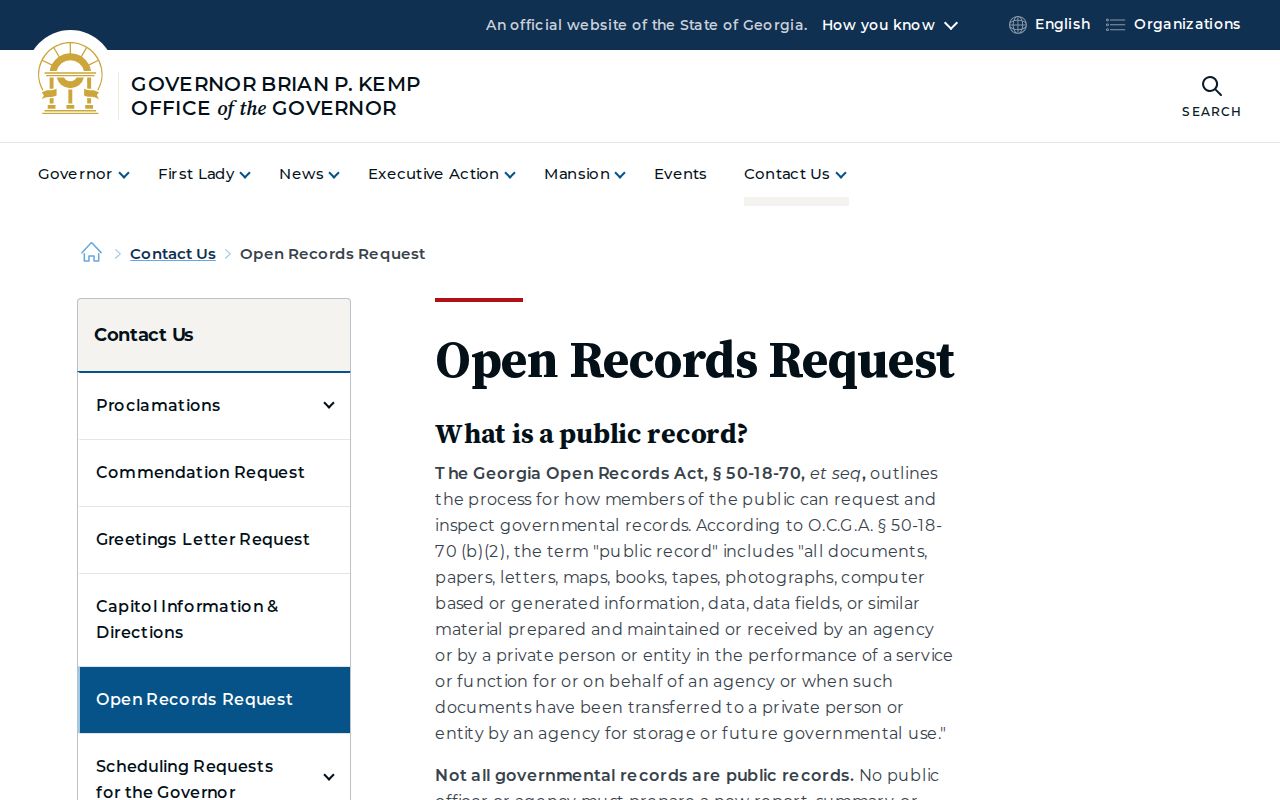
The state open-records route works well for county records and policy questions. A specific court document still belongs with the court that maintains it.